
Sokoban YASC 1.690 has been published
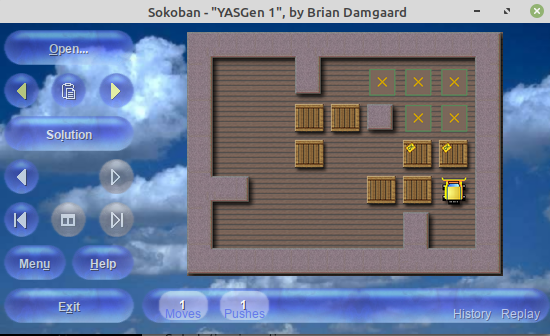
Brian Damgaard has published a new version of his great and widely used Sokoban YASC program.
The release notes for this new version:
- Updated the plug-in script for the JSoko optimizer to support the new "Moves, using rearrangements" optimization method introduced in JSoko version 2.29.
Note that the JSoko application itself is not bundled with Sokoban YASC and must be downloaded separately from ist official website. - Bugfix: Corrected a parameter handling mistake in the built-in SokLisp scripting language for the functions "substitute", "remove", and "remove-duplicates" (including their in-place modification variants and predicate versions).
When operating on lists, the optional "start" and "end" parameters were incorrectly filtering the entire input list beforehand rather than restricting the Operation to the specified range.
Vectors, strings, and tables were unaffected by this issue. - Minor changes.
JSoko 2.29 has been published
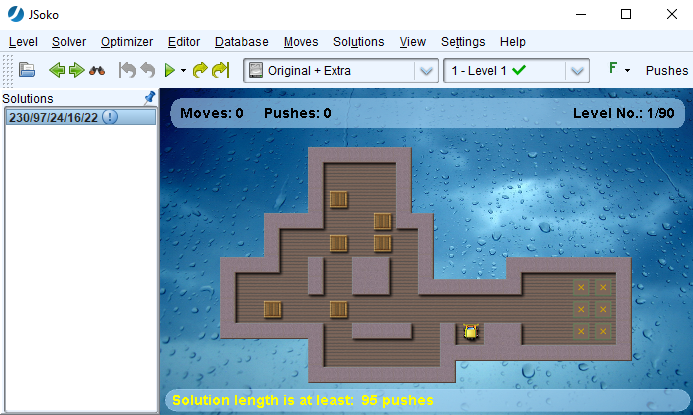
A new JSoko version has been released.
Please check out the release notes.
Please report any bugs, problems or suggestions to: JSoko@mail.de
JSoko 2.28 has been published
A new JSoko version has been released.
Please check out the release notes.
Please report any bugs, problems or suggestions to: JSoko@mail.de
YSokoban 1.853 has been published
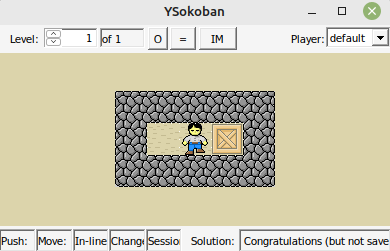
George Petrov has published YSokoban 1.853.
The release notes for this new version:
- Bugfix: hanging when creating RLE packed solution.
A feature comparison of the main Sokoban programs can be found in the Sokoban Wiki.
Sokoban YASC 1.689 has been published
Brian Damgaard has published a new version of his great and widely used Sokoban YASC program.
The release notes for this new version:
- Aesthetic improvement: Sokoban YASC provides "Settings" windows for external solver and optimizer plug-ins, each of which can be assigned an individual color theme.
A new and graphically much improved suite of color themes now substitutes the previously offered color choices. - Minor changes.
JSoko 2.27 has been published
A new JSoko version has been released.
Please check out the release notes.
Please report any bugs, problems or suggestions to: JSoko@mail.de
Sokoban YASC 1.688 has been published
Brian Damgaard has published a new version of his great and widely used Sokoban YASC program.
The release notes for this new version:
- New feature: Solve puzzle from current position (middle-click the "Solution" button or Ctrl+Q)
This allows for solver tasks to be initiated directly from any mid-puzzle game state during active play in the main window.
The presence of a "Solver" button on the status bar indicates an active solver task; the button's disappearance serves as the primary signal that all solver tasks have concluded.
A successful search automatically adds the newly found solution to the "Snapshots and Solutions" window, while the absence of a new entry indicates that the solver was unable to find a solution from that specific game state.
The ease of launching the solver from the main window necessitates a similarly easy way to stop it.
A right-click on the "Solver" button terminates the current solver task and allows the solver to proceed to the next task in the queue, if any. - Added a new option in the "Settings" window: "Control | Tools | Solver | Stop if a solution exceeds the length limit", with default value "Yes".
This serves as a guard for situations where a solver finds a solution that is too long for Sokoban YASC to register.
Previously, a batch run would simply proceed to the next puzzle, and it could go unnoticed that a solver plugin actually had solved the puzzle.
While not ideal, this new option at least ensures that the situation is reported rather than the result being silently skipped. - Text rendering improvement
In the "Snapshots and Solutions" window, individual list items were rendered with a fixed and rather small 8-pixel default size.
These items now honor the font size specified in "Settings -> Graphics -> Snapshots and Solutions -> Window font".
Thanks to Matthias Meger for reporting this issue. - Bugfix (1.686): Resolved a remaining scaling issue for multi-monitor configurations.
While the menu buttons, their font sizes, and the status bar scaled correctly across different displays, the status bar's text font size was still calculated based on the primary monitor's resolution rather than the monitor currently hosting the gameplay window.
Thanks to Matthias Meger for reporting this bug. - Bugfix: If a solver plug-in returned a solution exceeding the program’s supported length, a severe error message was displayed.
The check had stopped working, but no harm was done, and the program continued to run normally after the message was closed.
Thanks to Wayne Campbell for reporting this bug. - Minor changes.
YSokoban 1.852 has been published
George Petrov has published YSokoban 1.852.
The release notes for this new version:
- Bugfix: consider closed levels with unmovable boxes at level border.
An example puzzle of this kind:
A feature comparison of the main Sokoban programs can be found in the Sokoban Wiki.
JSoko 2.26 has been published
A new JSoko version has been released.
Please check out the release notes.
Please report any bugs, problems or suggestions to: JSoko@mail.de
Sokoban YASC 1.687 has been published
Brian Damgaard has published a new version of his great and widely used Sokoban YASC program.
The release notes for this new version:
- Bugfix (1.686): Loading external solver and optimizer plug-ins had stopped working.
This was a side effect of a minor improvement to bring the application’s terminology into alignment with Dictionary standards by changing "plugin" to "plug-in" throughout the user interface.
Unfortunately, an internal reference to the "Plugins" folder - which needs to retain its original spelling to function - was inadvertently caught in this global update.
Sokoban YASC 1.686 has been published
Brian Damgaard has published a new version of his great and widely used Sokoban YASC program.
The release notes for this new version:
- Enhanced the scaling logic for the main gameplay window to provide a seamless experience in multi-monitor configurations.
Previously, the scaling factor for menu buttons and the status bar was calculated only once at program launch based on the primary monitor's resolution.
The program now dynamically detects the resolution of the specific monitor currently hosting the gameplay window and adjusts the scaling accordingly.
Thanks to Matthias Meger for testing this feature enhancement. Bugfix (1.684): Restored the ability to disable automatic scaling for the menu and status bar.
The program had stopped honoring the manual override in the "Settings" window.
Thanks to Matthias Meger for reporting this bug.Bugfix (1.684): Corrected the auto-advance behavior for the Music player.
Previously, if a track failed to play, the player would jump back to the first file in the folder instead of moving on to the next valid track.
Additionally, there was an issue with manual navigation where moving backward to a previous track would fail to skip past a non-playing track.
Moving forward worked correctly.Minor changes.
Sokoban YASC 1.685 has been published
Brian Damgaard has published a new version of his great and widely used Sokoban YASC program.
The release notes for this new version:
- Access to music player
"Settings" window to perform basic music player tasks.
Once the music player is enabled in "Settings", a discreet button appears on the status bar in the main gameplay window.
The button supports the following interactions: Left-click: Play/Pause. Mouse wheel:
Previous/Next track. Right-click: Select music folder.
- Minor changes.
Sokoban YASC 1.684 has been published
Brian Damgaard has published a new version of his great and widely used Sokoban YASC program.
The release notes for this new version:
- New feature: Puzzle-specific backgrounds
This feature allows each puzzle to have its own unique backdrop as seen, for instance, in the Christmas-themed "Santaban" Sokoban clone.
Using "Santaban" as a running example, to implement such a mission pack in Sokoban YASC, the puzzle file header must include the key-value pair
Skin: Santaban
The specified skin file must be placed in the "...\Skins\Common Skins" folder.
The skin sets the option "Graphics - Board - Background - Level-specific backgrounds enabled" to "Yes" and makes walls, floors, and goals transparent to reveal the artwork.
The individual puzzle background images are stored in the dedicated subfolder "...\Mission Packs\Santaban\Assets\Graphics\Backgrounds".
Puzzles and background images are paired based on names; for example, a puzzle named "Santaban 01" has a matching background image named "Santaban 01.png".
For a limited time following this release, the Santaban mission pack is available for download here:
https://www.dropbox.com/scl/fi/8bkb6hmu3p1iuqwysbcd7/Santaban_1-04-2026_Setup.exe?rlkey=mc9qx4sx3aiklarrqrsqxv23t&st=zqrp74li&dl=1
This dual-installer bundles the legacy program-featuring an integrated keyboard compatibility workaround-with the Total Conversion for Sokoban YASC.
Please note that the Total Conversion is currently an active work-in-progress; remaining puzzles await conversion in future updates. - The original Sokoban YASC music player has been resurrected.
While reintroduced primarily to support mission packs like "Santaban", the music player is also available for general use.
In "Settings", a new "Music" section has been added with two options: "Music enabled" and "Music folder".
This feature is intended as a lightweight background audio solution rather than a substitute for a dedicated media player.
It automatically plays the tracks contained within the selected folder as background music during gameplay.
Thanks to Matthias Meger for providing a reproducible scenario needed to resolve a vicious music player instability issue. - As a side effect of the puzzle-specific background feature, it is also possible for regular puzzle collections to force a specific skin selection.
By adding the key-value pair "Skin: " to the puzzle file header, the specified skin from the "...\Skins\Common Skins" folder will be loaded regardless of whether the collection utilizes individual background images.
Use of this feature is generally discouraged for standard collections, as the choice of skin is typically left to the user's discretion.
This functionality should be reserved only for cases where a specific visual style is essential for the intended experience. - Renamed the "KenBri - Directional Player" skin to simply "KenBri" to establish it as the default variant of this skin.
The "KenBri - Walking Player" skin remains available as an optional variant.
- Minor changes.
Sokoban YASC 1.683 has been published
Brian Damgaard has published a new version of his great and widely used Sokoban YASC program.
The release notes for this new version:
- Improved the support for Asian languages a little.
Before the emergence of the Unicode text encoding system, languages like Japanese and Chinese used a text encoding with both 1-byte characters and 2-byte characters.
Sokoban YASC processes all texts as having single-byte characters only, with the result that cleansing puzzle titles for unwanted and illegal characters (e.g., quotes) often caused the program to mistake the second half of a 2-byte character for a single character to be deleted.
This caused spelling errors and garbled puzzle titles on the screen.
Now the text cleansing routines make an effort to handle 2-byte characters correctly.
Users of multibyte languages may also need to adjust several program font settings, such as those found under:
"Settings -> Graphics -> Open window -> Window font" and
"Settings -> Graphics -> Tools -> Window font".
Thanks to Minoru Yoshitani for suggesting and testing this feature. - When displaying the player's legal moves, directional avatars now revert to their neutral direction if the skin lacks a dedicated "highlight player" animation.
For humanoid avatars, this typically means facing the spectator.
This replaces the previous behavior where the avatar maintained the direction of its last move. Thanks to Matthias Meger for this suggestion. - Bugfix (1.682): Importing skins in the "Sokoban for Windows" format had stopped working.
- Minor changes.
Sokoban YASC 1.682 has been published
Brian Damgaard has published a new version of his great and widely used Sokoban YASC program.
The release notes for this new version:
- New feature: Walking player animation.
This is an alternative to the simpler "directional player" animation, which has always been capable of showing a player avatar with directional orientation (e.g., an arrow-shaped avatar reflecting the direction of movement).
The walking player animation features separate animations for walking and pushing.
The skin format has been extended accordingly (see the detailed layout description added to the built-in help).
A new speed control parameter has been introduced to regulate the duration of the animation sequence:
"Settings | Animation | Walking player animation | Do move (milliseconds)".
This dedicated setting is necessary to prevent the animation sequence from being rendered too quickly, which would negate the visual effect. - Added a new "KenBri - Walking Player" Public Domain skin with walking player imagery.
The original concept and foundational elements for this skin were generously placed in the Public Domain by Kenney Vleugels (via the CC0 dedication).
Building upon this base, the resulting "KenBri" skin features significant, high-impact contributions by Brian Damgaard.
Due to its graphical quality, gameplay suitability, and broad applicability for the Sokoban game, this skin is also donated to the Public Domain under the CC0 license.
For full details, please see the accompanying description:
In the skin selector window, select the skin and then choose "Menu -> Image text..." - Added a new "KenBri - Directional Player" skin, featuring a directional player avatar in place of a walking animation.
This player drawing, processed and re-rendered using AI image tools, features a cartoon-style player drawing with advanced, professional-grade shading and depth.
Graphic artists are highly encouraged to develop walking player imagery based on this drawing.
Such contributions would enable a future unified skin variant, serving as a replacement for the existing "KenBri - Walking Player" skin.
Due to its graphical quality, gameplay suitability, and broad applicability for the Sokoban game, this skin is also donated to the Public Domain under the CC0 license.
For full details, please see the accompanying description:
In the skin selector window, select the skin and then choose "Menu -> Image text...". - The KSokoban skin has been replaced with a comprehensively updated version, achieving significant improvements in both aesthetics and gameplay clarity.
While the original skin possessed strong ray-traced foundations, it was critically flawed by design inconsistencies and poor color choices that hampered visibility.
This new version resolves those issues, introducing a consistent theme, a highly visible yellow gemstone for the player, and a new blue diamond for boxes-on-goals.
This refined version is intended to become a worldwide replacement for this classic skin.
The skin contains a detailed breakdown of all the modifications:
In the skin selector window, select the skin and then choose "Menu -> Image text...".
Thanks to Matthias Meger for valuable contributions to this skin. - The oldest section of puzzles from the YASGen collection - the "Greek Mythology" section - has been discarded, as these were early examples of auto-generated puzzles possessing little or no human appeal; they were predominantly perceived as chaotic random sequences of pushes that suddenly yielded a solution.
The key lessons learned were that auto-generated puzzles must either be small (e.g., four boxes), a size at which the chaotic element is successfully contained and perceived as a stimulating challenge, or - for larger auto-generated puzzles - they must exhibit structure, such as featuring a goal-room theme or connected goals, in order to introduce identifiable objectives.
One discarded puzzle deserving of honorable mention is "Hera":
"9#|#.$.--*@#|#--.$*$$#|##-$*-*-#|#3-*3-#|#-#$.$#.#|#.$-.--.#|9#".
This 7x6 puzzle (not countng exterior walls), with 39 interior floor squares, held the longest known optimal solution of its size class (for conventional puzzles, not recursive so-called "Fibonacci puzzles") and illustrates the practically unsolvable complexity achievable by auto-generation within such small dimensions. - The Haywood puzzle collection has been streamlined by discarding the older "SokEvo" puzzle set - which shared the same design shortcomings as the early YASGen puzzles (detailed in the preceding entry) - and retaining only the "SokHard" set, with the entire collection renamed accordingly.
Furthermore, to enhance visual variety and appeal, redundant walls have been removed from all remaining puzzles in the collection.
One discarded puzzle deserving of honorable mention is "Teresa":
"7#|#+$--.#|#*$*$-#|#-$--.#|#.$*$-#|#.--.-#|7#",
which was proven to have the longest push-optimal solution in the class of 5x5 puzzles (excluding exterior walls) with nine boxes and no interior walls. - All hint texts and menu captions across the application have been inspected and refined using AI tools to improve consistency and bring the language closer to idiomatic English.
- Windows 11 compatibility: The former logic utilized a two-step process for installing the accompanying Sokoban game skins:
unpacking them to a shared, common program directory (as unmodified source files) followed by a copy operation to the individual user's skin folder (where modification is permitted).
This design was intended to maintain a clean source copy of all standard skins.
The subsequent copy step failed on certain installations, notably those running Windows 11, likely due to elevated operating system privilege restrictions.
The installer package now bypasses the intermediate common folder and writes all accompanying skins directly to the user's local skin folder during installation and updates.
This ensures all skins are accessible and modifiable by the user.
However, this also means that any local modifications to the default skin files will be overwritten during future updates, so users should make their own copy of a skin before modifying it. - Minor changes.
Sokoban YASC 1.681 has been published
Brian Damgaard has published a new version of his great and widely used Sokoban YASC program.
The release notes for this new version:
- Added a plug-in script for the BoxSearch Sokoban solver by Ge Yong.
The script seamlessly integrates BoxSearch into the Sokoban YASC environment, allowing users to launch, stop, and manage tasks directly from the solver task queue.
As with other supported solvers (such as Festival and Sokolution), the BoxSearch program itself must be downloaded separately from its website due to licensing restrictions. - Enhanced the "Macintosh" Sokoban skin by Scott Lindhurst.
The player (ladybug) and the boxes (marbles) now have a perfectly rounded shape.
This resolves the slightly irregular outlines that appeared after the original skin was converted to the larger 64x64 pixel format. - Addressed an issue with unexpected undo operations in reverse mode, when a user switches between using the mouse and the keyboard.
A jump is a special move at the start of a reverse mode game that allows the player to bypass walls and boxes to get from one area to another.
The program's behavior differed depending on the input method used for the jump.
Keyboard jumps:
The user manually guides the player along the jump's path.
Because the users are aware of this path, they can easily recognize if a subsequent keyboard move steps back along it.
In this case, the user isn't surprised to see the program interpret the move as an undo operation.
While the user might be mildly surprised to see the program (for practical reasons) reverse the entire jump, the action is overall predictable and understandable.
Mouse jumps:
A mouse jump is performed by simply clicking the destination square.
The program automatically calculates the path, and while the moves are shown on the board, the user typically doesn't pay close attention to the specific path taken.
The issue arose when a user performed a mouse jump and then used the keyboard for the very next move.
If this keyboard move happened to fall on the program's jump path, the program would interpret it as an undo, effectively "teleporting" the player back to the starting position.
This was confusing for the user, who was unaware of the path and the fact that the keyboard move had triggered an undo.
The program now never treats a keyboard move made immediately after a jump as an undo operation.
This prevents the player from unexpectedly being sent back to the jump's starting position.
Thanks to Carlos Montiers for bringing this up. - Minor changes.
Sokoban for Windows 3.4 build 5 has been published
Björn Källmark has published Sokoban for Windows version 3.4 build 4.
Release notes for this version:
- Fixed: Crash in select files to download
Fixed: Live update crash when upgrading Sokoban.exe
A feature comparison of the main Sokoban programs can be found in the Sokoban Wiki.
Sokoban YASC 1.680 has been published
Brian Damgaard has published a new version of his great and widely used Sokoban YASC program.
The release notes for this new version:
- Replaced the original "YASC 20 Years" puzzle with an improved version.
Originally created by DrFogh to mark the 20th anniversary of YASC on 2021-12-02, and subsequently refined through contributions by DrFogh and Anian. Thanks to both for this puzzle.
Sokoban for Windows 3.4 build 4 has been published
Björn Källmark has published Sokoban for Windows version 3.4 build 4.
Release notes for this version:
- Crash in purge scores fixed
Problem with time handling fixed
A feature comparison of the main Sokoban programs can be found in the Sokoban Wiki.
Sokoban for Windows 3.4 build 3 has been published
Björn Källmark has published Sokoban for Windows version 3.4 build 3.
Release notes for this version:
- Fixed: Deleted skin file caused prroblem
Fixed: Problemreporter fixed
Fixed: Finished level stepped over the next level
Fixed: Minor bugs fixed
A feature comparison of the main Sokoban programs can be found in the Sokoban Wiki.
Sokoban for Windows 3.4 build 2 has been published
Björn Källmark has published Sokoban for Windows version 3.4 build 2.
Release notes for this version:
- Access violation because of debug code in production release
A feature comparison of the main Sokoban programs can be found in the Sokoban Wiki.
Sokoban for Windows 3.4 build 1 has been published
Björn Källmark has published Sokoban for Windows version 3.4 build 1.
Release notes for this version:
- Stability improvements
- Number of players is now restricted to four
- First step to make individual Top Solvers lists
- Improved Option dialogs
- Improved database handling
- And much more
A feature comparison of the main Sokoban programs can be found in the Sokoban Wiki.
YSokoban 1.851 has been published
George Petrov has published YSokoban 1.851.
The release notes for this new version:
- Bugfix: wrong calculation of "changes" and "Inlines" during undo on right/left rotated level.
A feature comparison of the main Sokoban programs can be found in the Sokoban Wiki.
JSoko 2.25 has been published
A new JSoko version has been released.
Please check out the release notes.
Please report any bugs, problems or suggestions to: JSoko@mail.de
JSoko 2.24 has been published
A new JSoko version has been released.
Please check out the release notes.
Please report any bugs, problems or suggestions to: JSoko@mail.de
JSoko 2.23 has been published
A new JSoko version has been released.
Please check out the release notes.
Please report any bugs, problems or suggestions to: JSoko@mail.de
Sokoban YASC 1.679 has been published
Brian Damgaard has published a new version of his great and widely used Sokoban YASC program.
The release notes for this new version:
- New puzzle editor feature: Convert untraversed floor squares to wall squares.
This new tool enables puzzle authors to automatically convert floor tiles unused in existing solutions and snapshots to wall tiles.
It contributes to the puzzle creation process by removing unnecessary open space, resulting in cleaner and more focused puzzle designs.
Thanks to Matthias Meger and Anian Wu for this suggestion. - The thread limit for the Sokolution solver plug-in has been raised from 85% to 100% of the available logical CPU cores.
- Minor changes.
Sokolution 7.33 has been published
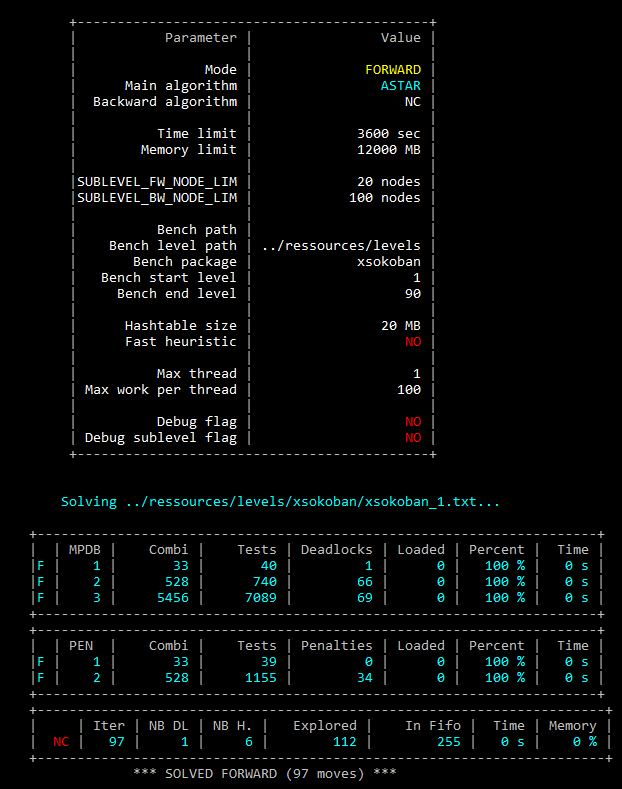
Florent Diedler has released a new version of Sokolution - one of the best Sokoban solvers.
Release notes for version 7.33:
- Fixed another crash when the level had more than 1024 floors.
You can find details about which levels have been solved in the Sokoban Wiki.
Sokolution 7.3 and 7.31 have been published
Florent Diedler has released a new version of Sokolution - one of the best Sokoban solvers.
Release notes for version 7.3:
- Add the ability to solve big levels (levels with more than 255 floors)
- Add the solver version in the parameter viewer when Sokolution is launched by the batch file or the command-line
- Fix "extended" searches modes that was not launched correctly
- Fix a crash (Thanks for Brian for reporting me that bug)
- Fix an issue where some levels could not be solved if using a single search mode (Thanks for Matthias for reporting me this issue)
- Misc improvements
- Fixed a crash
You can find details about which levels have been solved in the Sokoban Wiki.
Sokoban YASC 1.678 has been published
Brian Damgaard has published a new version of his great and widely used Sokoban YASC program.
The release notes for this new version:
- Updated the Sokolution solver plug-in to support the new features and accommodate the new parameter syntax introduced in Sokolution version 7.2.
Sokoban YASC includes plug-in scripts for several major solvers, such as Sokolution by Florent Diedler and Festival by Yaron Shoham.
These programs must be downloaded separately from their respective websites due to license restrictions.
Once installed, the plug-in scripts seamlessly integrate these external programs into the Sokoban YASC environment, allowing users to launch, stop, and manage tasks from the solver queue.
Thanks to Matthias Meger and Florent Diedler for contributing to this update.
- Minor changes.
Sokolution 7.2 and 7.21 have been published
Florent Diedler has released new versions of Sokolution - one of the best Sokoban solvers.
Release notes for version 7.2:
- Fix bugs and a crash with push-optimal solutions (Thanks to Matthias)
- Add all non optimal algorithms
- Unify parameters --solver-mode and --solver-optimal-mode to one parameter
- Add a new "extended" search mode (Thanks Brian for suggesting the word "extended" and Matthias for your feedback about this word) for complicated levels
- Change default parameter --solver-mpdb-size from 2 to 3
- Change default parameter --solver-strong-deadlock from 0 to 1
- Misc improvements
Release notes for version 7.21:
- Fix an overflow for a counter for large collection
You can find details about which levels have been solved in the Sokoban Wiki.
Sokolution 7.11 has been published
Florent Diedler has released new versions of Sokolution - one of the best Sokoban solvers.
Version 7.1 is a special version that only searches for push optimal solutions.
Release notes for version 7.11:
- Fix a bug with optimal solutions
- Fix a crash in the penalty engine
You can find details about which levels have been solved in the Sokoban Wiki.
Sokolution 7.1 has been published
Florent Diedler has released new versions of Sokolution - one of the best Sokoban solvers.
Version 7.1 is a special version that only searches for push optimal solutions.
Release notes for version 7.1:
- Invert lines in the bench csv file for Brian's script
- Improve penalty engine thanks to Matthias : use an enhanced heuristic to detect complex penalties
- Misc improvements
- Fix some bugs
You can find details about which levels have been solved in the Sokoban Wiki.
Sokolution version 6.34 and Sokolution 7.0 have been published
Florent Diedler has released new versions of Sokolution - one of the best Sokoban solvers.
Version 6.34 fixes some bugs compared to version 6.33
Version 7.0 is a special version that only searches for push optimal solutions.
Change log for version 6.34:
- Fix a rare memory corruption
- Fix a bug with symmetry (Thanks Matthias for reporting this bug)
- Fix a bug in diagonal deadlock
Release notes for version 7.0:
- Use a powerful penalty engine for trying to find optimal solutions
- Add a control to check if the solution is really optimal according to solutions found on Sokobano.de website. This control works only for XSokoban, Microban, Microban II and Sasquatch level sets
- Fix the parameter "nbCores" to limit the CPU load used by Sokolution
- Add informations for the user for the generation of the MPDB and MPPDB that could be long
- Misc improvements
You can find details about which levels have been solved in the Sokoban Wiki.
YSokoban 1.850 has been published
George Petrov has published YSokoban 1.850.
The release notes for this new version:
- Bugfix: rare crash during export of solutions.
A feature comparison of the main Sokoban programs can be found in the Sokoban Wiki.
Sokoban YASC 1.677 has been published
Brian Damgaard has published a new version of his great and widely used Sokoban YASC program.
The release notes for this new version:
- The "Find similar puzzles" variant of the puzzle duplicate finder has been significantly improved.
It now uses the Levenshtein edit distance algorithm for comparisons. ("Levenshtein" is spelled correctly - it's not a typo.)
Previously, this variant relied on a simpler, more direct comparison method.
While it also used normalized puzzle boards and also allowed for a match threshold percentage to account for variations, the results were less flexible than those achieved with the new algorithm.
The other two duplicate finder variants, "Find all duplicate puzzles" and "Find duplicates of the current collection", remain unchanged.
They still search for exact duplicates (considering puzzle normalization) rather than similar puzzles, as the computational cost of a similarity-based search would be prohibitive. - The built-in puzzle generator has been enhanced to produce better-quality puzzles.
Previously, it was prone to carving dead-end tunnels and placing goals or boxes in them.
While this was an easy way for the generator to increase the number of pushes - a key metric for creating more complex and interesting puzzles - such puzzles often turned out to be trivial and too easy to solve.
For example, here is an auto-generated puzzle with a promising beginning, but after unwinding its initial knot, the remainder becomes trivial:
"--9#|--#3-4.#|--#--6#|--#3-#|3#-$-#|#-$--4#|#7-#|4#-$$-#|3-##@-##|4-4#".
The improved algorithm now avoids creating dead-end tunnels in most cases, resulting in more challenging puzzles. - Bugfix: Filling the optimizer task queue with solutions from a puzzle file containing thousands of puzzles can take so long time that the user might choose to switch to another application during the import.
This worked as expected, but if the user switched to the Windows desktop instead of another application, then a harmless but highly technical error message would appear on the screen.
After dismissing the message, the user could restart the import from where it left off.
This issue has now been resolved for the optimizer task queue and the puzzle generator task queue.
The solver task queue, which uses a similar import mechanism, already handled this scenario correctly.
- Minor changes.
YSokoban 1.849 has been published
George Petrov has published YSokoban 1.849.
The release notes for this new version:
- Bugfix: rare crash during save of a solution.
A feature comparison of the main Sokoban programs can be found in the Sokoban Wiki.
Sokoban YASC 1.676 has been published
Brian Damgaard has published a new version of his great and widely used Sokoban YASC program. There are also new versions of the optimizer (YASO) and the solver (YASS).
The release notes for this new version:
- The puzzle file format has undergone a major overhaul, most notably abandoning the run-length encoding feature.
This includes both the simple form that allowed moves like 'rrrUUUU' to be encoded as '3r4U', and the advanced grouping form that encoded moves like 'rrUUUrrUUU' as '2(2r3U)'.
The feature was not only never used in practice, but there was no real need for it.
For programmers, it greatly increased the implementation complexity, far more than could be justified.
Thanks to Matthias Meger and Eric Sunshine for their valuable contributions to both the file format and its description. - New feature: The application now includes an automatic "Check for Updates" feature, installing updates automatically when available.
The update check frequency can be customized with options for weekly, monthly, yearly, or never. To adjust these settings, go to "Settings | Control | Miscellaneous". - New feature: A graphical user interface (GUI) is now available for configuring all solver and optimizer plugins that come with Sokoban YASC.
The program includes plugin scripts for several major solvers (e.g., Festival) and optimizers (e.g., JSoko). While the YASS solver and YASO optimizer are bundled with Sokoban YASC, the other programs must be downloaded separately from their respective websites due to license restrictions.
Once installed, the provided plugin scripts seamlessly integrate these external programs into the Sokoban YASC environment, allowing users to launch, stop, and manage tasks from the solver and optimizer queues.
Previously, the only way to adjust settings such as 'time limit' or 'memory limit' for these external programs was by manually editing plain text files.
Although functional, this method was far less user-friendly than a graphical user interface with checkboxes, radio buttons, drop-down lists for multiple choices, and other common GUI elements.
The novelty is that the underlying SokLisp scripting language has been enhanced with the ability to support GUI windows.
This upgrade enables the plugin scripts to offer a much more convenient, user-friendly interface for managing the settings.
Additionally, it allows the plugins to offer new, advanced features, such as saving and swapping different sets of settings tailored for various types of tasks. - The accompanying solution optimizer uses four optimization strategies.
One of them, “Global Optimization,” often requires considerable time with only minimal chances of finding improvements.
Nevertheless, this method remains essential for optimizing secondary metrics, such as player lines, alongside moves and pushes.
This capability makes the method particularly valuable for finding truly optimal solutions in very small puzzles.
Now, the “Global Optimization” strategy includes a 50-million pushes limit, providing a more balanced trade-off between runtime and the likelihood of discovering improvements. - Minor changes.
JSoko 2.22 has been published
A new JSoko version has been released.
Please check out the release notes.
Please report any bugs, problems or suggestions to: JSoko@mail.de
JSoko 2.21 has been published
A new JSoko version has been released.
Please check out the release notes.
Please report any bugs, problems or suggestions to: JSoko@mail.de
JSoko 2.20 has been published
A new JSoko version has been released.
Please check out the release notes.
Please report any bugs, problems or suggestions to: JSoko@mail.de
JSoko 2.19 has been published
A new JSoko version has been released.
Please check out the release notes.
Please report any bugs, problems or suggestions to: JSoko@mail.de
Sokoban YASC 1.675 has been published
Brian Damgaard has published a new version of his great and widely used Sokoban YASC program.
The release notes for this new version:
- Bugfix (1.674):
When running an external solver or optimizer plugin, everything worked fine if the plugin was allowed to run to completion.
However, manually terminating the plugin had stopped working.
Thanks to Anian Wu and Matthias Meger for reporting this bug.
JSoko 2.18 has been published
A new JSoko version has been released.
Please check out the release notes.
Please report any bugs, problems or suggestions to: JSoko@mail.de
JSoko 2.17 has been published
A new JSoko version has been released.
Please check out the release notes.
Please report any bugs, problems or suggestions to: JSoko@mail.de
JSoko 2.16 has been published
A new JSoko version has been released.
Please check out the release notes.
Please report any bugs, problems or suggestions to: JSoko@mail.de
JSoko 2.15 has been published
A new JSoko version has been released.
Please check out the release notes.
Please report any bugs, problems or suggestions to: JSoko@mail.de
YSokoban 1.848 has been published
George Petrov has published YSokoban 1.848.
The release notes for this new version:
- Bugfix: macro stops working and does preform undo
- Bugfix: exported positions changed
- Bugfix: wrong display of a rotated level with skin which uses alternate wall.
A feature comparison of the main Sokoban programs can be found in the Sokoban Wiki.
YASS 2.151 published
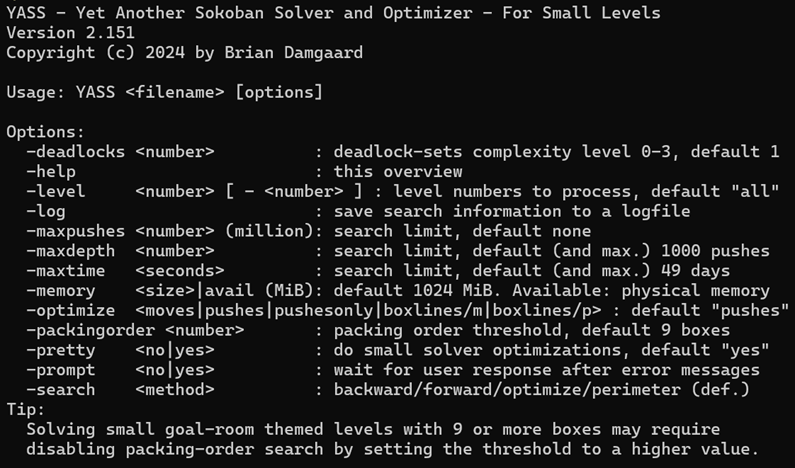
Brian Damgaard has published a new version of his Sokoban solver "YASS - Yet Another Sokoban Solver and Optimizer".
This version has improved support for running multiple instances of the solver simultaneously.
You can find details about which levels have been solved by which solver in the Sokoban Wiki or on the Sokoban Statistics Website.
Sokoban YASC 1.674 has been published
Brian Damgaard has published a new version of his great and widely used Sokoban YASC program.
The release notes for this new version:
- Reverse game play
While playing the game in reverse mode, there was a special case where the program correctly prevented pulls that would lead to a deadlock, but it didn't provide a message explaining this.
Thanks to Matthias Meger for reporting this omission. - Scripting language
Various improvements and bug fixes of the built-in SokLisp scripting language. - Minor changes
Sokolution version 6.33 has been published
Florent Diedler has released a new version of Sokolution - one of the best Sokoban solvers.
This is a bugfix version which replaces version 6.32.
Change log for version 6.33:
- Fix bugs due to symmetry thanks to Matthias
- Fix another small bug
You can find details about which levels have been solved in the Sokoban Wiki.
Sokolution version 6.32 has been published
Florent Diedler has released a new version of Sokolution - one of the best Sokoban solvers.
This is a bugfix version which replaces version 6.32.
Change log for version 6.33:
- Fix bugs due to symmetry thanks to Matthias
- Fix another small bug
You can find details about which levels have been solved in the Sokoban Wiki.
JSoko 2.14 has been published
A new JSoko version has been released.
Please check out the release notes.
Please report any bugs, problems or suggestions to: JSoko@mail.de
JSoko 2.13 has been published
A new JSoko version has been released.
Please check out the release notes.
Please report any bugs, problems or suggestions to: JSoko@mail.de
Sokolution version 6.3 has been published
Florent Diedler has released a new version of Sokolution - one of the best Sokoban solvers.
Change log for version 6.3:
- Allow to load some big levels by adding walls in "dead areas"
- Misc improvements
You can find details about which levels have been solved in the Sokoban Wiki.
Sokolution version 6.2 has been published
Florent Diedler has released a new version of Sokolution - one of the best Sokoban solvers.
Change log for version 6.2:
- Improved strategy for complicated levels
- Fix for possible memory corruption
You can find details about which levels have been solved in the Sokoban Wiki.
Sokoban for Windows 3.3 build 15 has been published
Björn Källmark has published Sokoban for Windows version 3.3 build 15.
Release notes for this version:
- Faster start
- Database problem for own files fixed.
- Start problem on new install fixed.
- Plus numerous other improvements.
A feature comparison of the main Sokoban programs can be found in the Sokoban Wiki.
Sokolution version 6.1 has been published
Florent Diedler has released a new version of Sokolution - one of the best Sokoban solvers.
Change log for version 6.1:
- Improve global speed of the solver
- Allow to solve more difficult levels...
You can find details about which levels have been solved in the Sokoban Wiki.
JSoko 2.11 and 2.12 have been published
A new JSoko version has been released.
Please check out the release notes.
Please report any bugs, problems or suggestions to: JSoko@mail.de
Sokoban for Windows 3.3 build 14 has been published
Björn Källmark has published Sokoban for Windows version 3.3 build 14.
Release notes for this version:
- Possible moves symbol scales.
- Font size setting for all dialogs.
- Animation speed has a wider range.
- Animation acceleration on/off selectable.
- Edit mode bugs fixed.
- Skins bug corrected.
- Plus numerous other improvements.
A feature comparison of the main Sokoban programs can be found in the Sokoban Wiki.
JSoko 2.10 has been published
A new JSoko version has been released.
Please check out the release notes.
Please report any bugs, problems or suggestions to: JSoko@mail.de
MOP for Sokoban 2.2 has been published
Takaken has published MOP for Sokoban 2.2, a program for playing the Sokoban game.
It offers many features such as support for solving a level by using a solver program and automatically pushing a box to a selected destination.
MOP for Sokoban 2.2 has been published
Takaken has published MOP for Sokoban 2.1, a program for playing the Sokoban game.
It offers many features such as support for solving a level by using a solver program and automatically pushing a box to a selected destination.
JSoko 2.09 has been published
A new JSoko version has been released.
Please check out the release notes.
Please report any bugs, problems or suggestions to: JSoko@mail.de
MOP for Sokoban 2.2 has been published
Takaken has published MOP for Sokoban 2.0, a program for playing the Sokoban game.
It offers many features such as support for solving a level by using a solver program and automatically pushing a box to a selected destination.
YSokoban 1.847 has been published
George Petrov has published YSokoban 1.847.
The release notes for this new version:
- Change: macro continues at the end of ()/{} even without *
- Change: play macro button changes to stop when started
- Added: command stopMacro
- Bugfix: make mixed case Ctrl-L
- Change: more optimization for RLE
A feature comparison of the main Sokoban programs can be found in the Sokoban Wiki.